 Oahu Whale Watching Tours
When Humpback Whales Arrive in Hawaii, and What You See
When do humpback whales arrive in Hawaii? The first scouts reach Hawaiian waters in late November, numbers build to a peak between January and March, and the stragglers are gone by May, headed back toward Alaska. Every animal makes that trip on a roughly 3,000-mile swim and largely stops eating for the season once it arrives. This guide walks the month-by-month timeline, the numbers behind it, and what a whale watching cruise or a shoreline lookout actually shows at each stage, alongside the whale watching cruises from Oahu that run through the season.
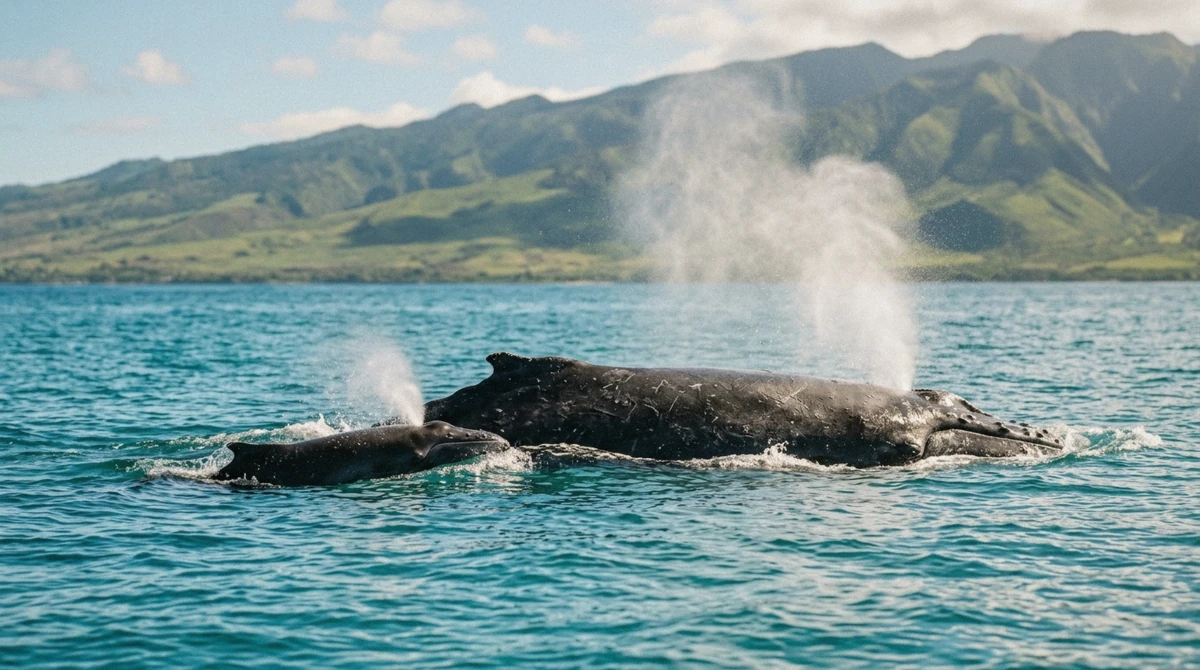
A humpback surfacing off Oahu during the winter migration window.
Quick answer
The first humpback whales reach Hawaiian waters in late November, the season builds to peak density between January and March, and most whales have left by May. Nearly the entire population makes the trip from Alaska specifically to breed, calve, and nurse young in warm water, not to feed.
Key takeaways
- First arrivals: late November. Peak density: January through March. Stragglers linger into May
- The swim from Alaska covers roughly 3,000 miles, and whales essentially stop feeding once they reach Hawaii
- Mothers with newborn calves are most visible in February and March, the best window for that specific sighting
- The Sanctuary's volunteer Ocean Count runs the last Saturday of January, February, and March from shore lookouts
- How each operator defines the season differs by weeks; see the full season breakdown for all four Oahu cruises
- Peak months mean more competition for good viewing water; the cheapest listing in the catalog runs morning departures through the season
The Migration
Every humpback wintering in Hawaii makes the same long swim for the same reason.
A 3,000-mile swim, one way
Humpback whales that winter in Hawaii travel from feeding grounds off Alaska, a swim of roughly 3,000 miles each way. They make the trip on stored fat reserves built up over a summer of feeding in colder water, and once they arrive in Hawaii they largely stop eating for the season, living off that reserve until the return swim begins in spring. That round trip, out and back in a single season, is one of the longer annual migrations of any mammal on the planet, and it happens every single year rather than once in a whale's lifetime.
More than half the North Pacific population
Current estimates put the number of humpbacks wintering in Hawaiian waters at up to roughly 10,000, more than half of the entire North Pacific population. That concentration is why Hawaii, and Oahu specifically, sees reliable sightings across an entire winter season rather than occasional passing animals.
The whole population is not moving in sync
The 3,000-mile swim is not a single coordinated event. Adult males and non-pregnant females tend to travel first, arriving earlier in the season, while pregnant females often arrive later so they can give birth as close to arrival as possible, then linger longest into spring before making the return trip with a newborn calf. That staggered arrival and departure is a large part of why the season stretches across roughly six months from first sighting to last, rather than compressing into a few sharp weeks.
Arrival Timeline
The season builds gradually, peaks hard in mid-winter, and tapers rather than stopping on a fixed date.
Month by month, what shows up off Oahu
The table below tracks who arrives and what a boat or shore lookout typically sees at each stage of the season.
| Month | Who arrives | What you see from Oahu |
|---|---|---|
| November | First scouts, mostly single adults | Occasional distant blows; sightings are not yet reliable |
| December | Numbers build steadily | Blows and tail slaps become common on cruises; still building toward peak |
| January | Peak density begins | Reliable sightings on most departures; competing males and surface activity |
| February | Peak season; mothers with newborn calves arrive | Best month for calf sightings; frequent blows, fluke dives, occasional breaches |
| March | Peak continues; more calves visible | Same high density as February; Ocean Count runs its final shore survey of the season |
| April | Numbers taper | Sightings less frequent but still common on most cruises |
| May | Stragglers only | Sightings become occasional; most of the population has begun the return swim |
Operators do not agree on exact edges
The month-by-month pattern above reflects the general NOAA timeline, but individual operators publish narrower or wider windows for their own cruises, and reviewers report occasional no-whale trips clustering at the early-December and late-April edges of the season. The detailed comparison of what each operator actually claims covers those differences directly, since booking near the edges of the season carries more risk of a quiet trip than booking in January through March.
Why the published windows differ at all
Part of the disagreement comes down to how conservative each operator wants to be with a guarantee. A narrower published window, like December to March, sets expectations an operator can consistently meet, while a wider claim of December through May captures the full range NOAA describes but leans on the thinner edges of the season where sightings are least reliable. Neither claim is wrong on its own terms; they simply describe different slices of the same underlying migration curve, and the practical takeaway is the same regardless of which listing is booked: the middle of the window beats either edge.
Why Hawaii
The same warm, shallow water draws the population back every winter.
Warm, shallow water built for calving
Hawaiian waters are warm and comparatively shallow near shore, conditions that suit newborn calves far better than the cold feeding grounds off Alaska. Humpbacks return here specifically to breed and to give birth, using the warm water as a nursery before calves are strong enough to attempt the long return swim.
Protected by sanctuary boundaries
The waters around Oahu and the other main Hawaiian islands fall inside the Hawaiian Islands Humpback Whale National Marine Sanctuary, which sets vessel-approach limits and other protections specifically because of how much of the population concentrates here each winter. Those boundaries are also why every boat in the Oahu catalog holds a fixed distance from the animals rather than approaching freely.
Shallow water suits a newborn calf's limits
A newborn calf cannot yet dive deep or hold its breath the way an adult can, so the shallow reef flats and channels around the main islands give a mother a safer place to nurse and let a calf build strength before the swim back toward Alaska. That same shallow water is part of why boat-based sightings on Oahu's south shore, rather than the open ocean further out, produce some of the most reliable mother-and-calf viewing in the season.
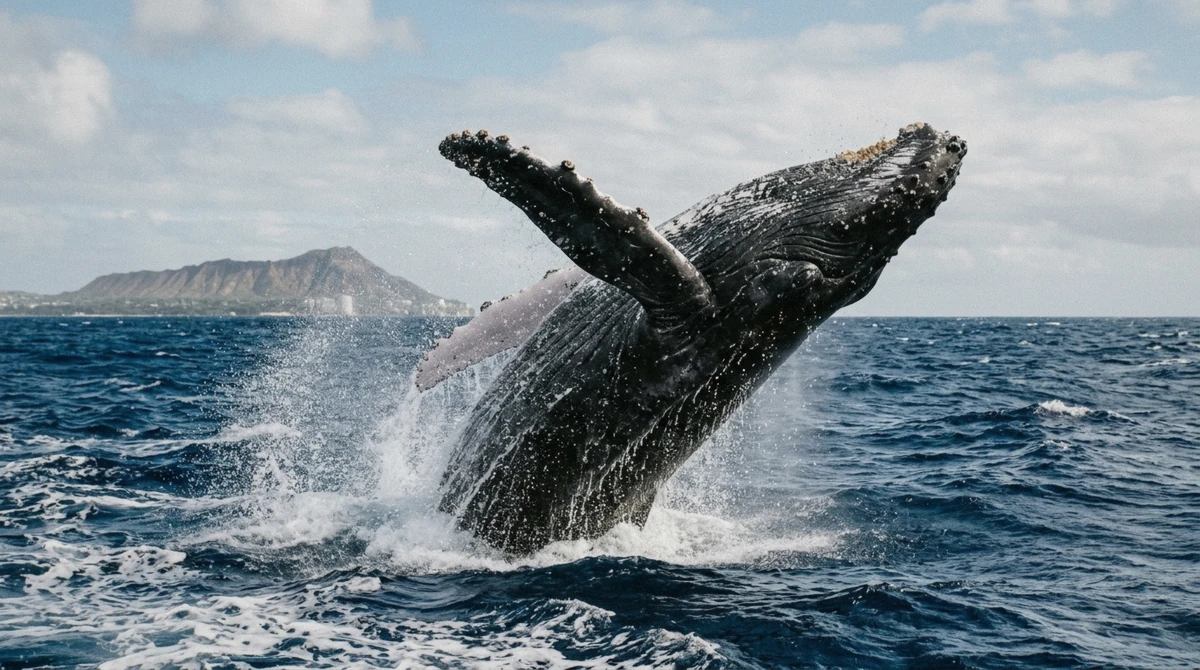
Peak migration months put the most active whales, including breaching adults, off Oahu's south shore.
Behaviors You Might See
A short glossary of what surfaces during a sighting.
Blows, breaches, and fluke dives
The most common surface behaviors are a blow, a breach, a tail slap, and a fluke-up dive that signals a whale is heading back down for several minutes. The full glossary of what each behavior looks like and how to time a photo around it lives on the homepage whale behavior guide; this page focuses on when to expect them rather than re-explaining each one.
Behavior shifts as the season moves along
Early in the season, single adults and competing males tend to produce more visible surface activity, including tail slaps and occasional breaches connected to competition over a female. By February and March, once mothers and calves make up a larger share of the animals in the water, sightings shift toward quieter, more repetitive surfacing as a calf practices breathing and diving alongside its mother. Neither pattern is fixed, but it explains why two trips booked a month apart can feel noticeably different even within the same peak season.
Population Numbers
The species has been recovering, but recent counts show the trend has reversed.
A population that grew, then declined
North Pacific humpback numbers were estimated at roughly 33,000 in 2012, a strong recovery from historical whaling-era lows. By 2021, that estimate had fallen to roughly 26,000, a decline researchers have linked in part to a major marine heatwave that disrupted feeding grounds in the years between those two counts. The current Hawaii-specific breeding estimate sits at up to roughly 10,000 animals wintering in the islands each year.
Ocean Count tracks the pattern from shore
The Sanctuary's Ocean Count is a volunteer shore-based survey that runs the last Saturday of January, February, and March each year, with observers stationed at points around the islands counting sightings during fixed windows. It is one of the longer-running community data sources on how the season is trending year to year, separate from any single operator's own sighting log.
Why the decline matters for a booked trip
A drop from roughly 33,000 to roughly 26,000 across the wider North Pacific population does not mean a given cruise is less likely to see a whale off Oahu specifically; the Hawaii breeding estimate of up to 10,000 has stayed a large share of that total through the decline. The number is worth knowing as context for how the species is doing overall, and it is part of why researchers keep running counts like Ocean Count each year rather than assuming a stable, self-sustaining population indefinitely.
Seeing Them from Oahu
Boats and shore lookouts both work, with different trade-offs.
Boats close the distance; shore is free
A boat cruise gets closer to the water where whales are surfacing and comes with a naturalist narrating behavior in real time, while shore lookouts cost nothing but rely on binoculars and distance. The four Oahu whale watching cruises run from the south shore near Kewalo Basin and Holomoana Street, and from Waianae on the west side; shore-based viewing is covered separately for anyone weighing the free option first.
What a boat adds beyond distance
Closing the distance is only part of what a boat changes. A naturalist on board can read a blow pattern and predict roughly where a whale will surface next, something a shore observer scanning open water without that context cannot do nearly as reliably. Boats also cover more water over the length of a cruise than a fixed shore point ever will, which matters most outside the peak months described above, when sightings are less dense and covering more ocean improves the odds of a sighting at all.
Peak months, and which cruise to book
January through March is the highest-density window described in the table above, which means better odds on any departure but also the busiest booking period. The sunset whale watch from Kewalo Basin carries the highest rating in the catalog and runs through peak season, while the West Oahu sail from Waianae has turned up spinner dolphins, sea turtles, and even a hammerhead shark in reviewer reports during the same months. Full season timing for each operator is broken down on the season comparison page.
Budget arrivals versus peak arrivals
A cruise booked in early December or late April costs the same as one booked in February, but the odds behind that price are not the same. Pink Sails Waikiki, the cheapest listing in the catalog at $53, runs two morning departures throughout the entire season including its opening and closing weeks, and includes a free re-ride if no whales are spotted, which is the more forgiving option for anyone booking near the edges of the migration window rather than its center.
Late November opens the season, January through March is peak, and by May the swim back to Alaska has mostly begun. The number that matters most for booking is not the calendar month alone but how close it sits to that January-to-March window, since every operator's quietest trips cluster at the edges rather than the middle of the season.
What is the best time to see humpback whales in Hawaii?
January through March is peak season, with the highest density of whales in Hawaiian waters and the best odds on any single cruise. February and March add the best chance of seeing mothers with newborn calves specifically.
Which Hawaiian island has seen the most whales?
Maui's Au'au Channel is the highest-concentration water in the state, thanks to its shallow, sheltered geography between islands. Oahu still sees reliable sightings through the season along its south and west shores; how Oahu compares to Maui for whale watching covers that trade-off in full.
How long does it take a humpback whale to swim from Alaska to Hawaii?
The swim covers roughly 3,000 miles, and whales make the crossing on stored fat reserves rather than feeding along the way. Exact travel time varies by individual whale, but the distance is why the migration takes weeks rather than days to fully arrive each winter.
What time of day are you most likely to see humpback whales?
Morning departures tend to have calmer water for spotting distant blows, which is part of why Waikiki Deluxe's 8 AM cruise runs early. Sightings happen throughout the day during peak season; the biggest factor is the month, not the hour.
Do humpback whales eat while they're in Hawaii?
Almost never. Whales arrive in Hawaii carrying fat reserves built up over a summer of feeding near Alaska, and they largely stop eating for the season once they reach warmer water, living off those reserves until the return swim begins.
How many humpback whales come to Hawaii each winter?
Current estimates put the number at up to roughly 10,000 whales wintering in Hawaiian waters, more than half the entire North Pacific population, which had declined from about 33,000 in 2012 to about 26,000 by 2021.
Is it worth booking a whale watching tour outside the peak months?
It's a real risk. Reviewers across the Oahu catalog report occasional no-whale trips clustering in early December and late April, right at the edges of the season, while January through March carries far better odds on any given departure.